
Emerging Leaders Prize fuels the future of research into young people’s mental health
A look at the future leaders receiving funding in our latest round of Emerging Leaders Prize awards.

Announcing the winners of our 2026 Emerging Leaders Prize.

Two outstanding scientists take home gold in this year’s Emerging Leaders Prize.
What did you eat and drink as a baby? How healthy were your parents? What kind of neighbourhood did you grow up in?
We increasingly understand how these foundations shape our health for years to come. Preventing ill health during the earliest stages of life is commonly thought to be more effective than treating it in later life, potentially saving £16 billion. Yet despite the clear long-term public health impact, this area of research is critically underfunded.
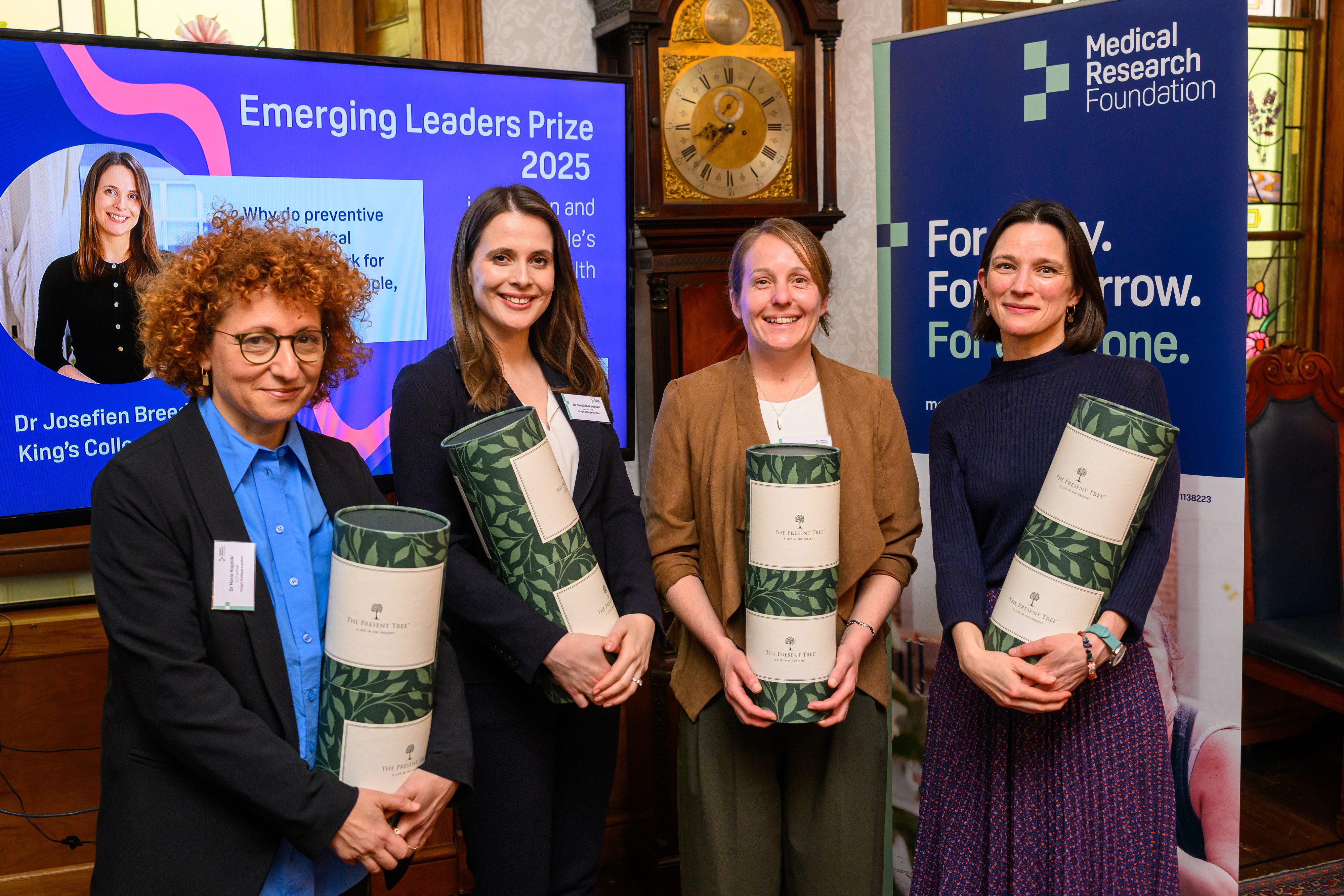
That’s why we’re investing in three research leaders of tomorrow whose studies will explore the biological and environmental influences that have a profound impact on our lifelong health and our risk of disease.
The Emerging Leaders Prize is an annual award which celebrates the achievements of scientists working in a specific field. The funding is designed to support their ongoing research and help them develop their careers, whether that be by investing in new technologies, taking up training opportunities, or developing research internships.
These awards are made possible by the generosity of our legacy donors, Professor Victor and Alicia Menage, and Audrey and Ronald Ramsey.
Previous prize-winners have used their funding to investigate how sexism and misogyny contribute to the gender divide in teenage mental health, how a warming climate might be making the spread of antibiotic-resistant superbugs worse, and how we can improve liver cancer diagnosis in people with hepatitis.
Your donation supports groundbreaking medical research for every mind and every body.
Support usThis year, we’re awarding two researchers the first-place prize of £100,000 each, with a runner up receiving £50,000. Their studies will all tackle head on the factors in early life that can contribute to disease, ensuring future generations stay healthier for longer. Because nobody should face a health condition without clarity and hope.
Read on to find out about the three researchers and their groundbreaking projects.

Joint First Place - £100,000: Dr Gemma Sullivan, University of Edinburgh
Being born prematurely is a leading cause of brain injury in childhood, with boys being particularly vulnerable. But why do boys’ and girls’ brains respond differently to premature birth, and how can we protect them? That’s what Gemma’s work aims to uncover, using mini-brains grown in the laboratory to study the differences in a particularly vulnerable type of brain cell known as an oligodendrocyte.
Part of the funding for this award was made possible by the generous gift of Audrey and Ronald Ramsey.
Gemma said, "Receiving the Emerging Leaders Prize from Medical Research UK is a real honour. This award will enable us to harness stem cell technology to better understand how preterm birth affects the developing brain and identify new ways to protect it.
"Ultimately, our goal is to translate these discoveries into personalised treatments that improve the lives of children and families affected by preterm birth."

Joint First Place - £100,000: Dr Divyangana Rakesh, King’s College London
A child’s social and economic environment will influence how their brain develops, with knock-on effects on their mental health. But this isn’t just at a household level; wider inequalities in society could have profound impacts on their emotional and cognitive development from birth too. This is what Divyangana will explore through her project, examining how societal inequalities shape health during infancy and into later life.
Divyangana said, “I am honoured to receive the Emerging Leaders Prize from Medical Research UK. This support will help us understand the role of macro-level contextual factors in young people's development whilst making strides towards more representative developmental neuroscience.
“I am so pleased and excited that my team and I can now act on this vision.”

Runner-Up - £50,000: Dr Mattia Gerli, University College London
Birth defects are a leading cause of death in newborn babies, yet the majority of these conditions go unexplained. Mattia will be investigating whether viruses hiding out in the amniotic fluid of the womb during pregnancy could be behind some of these birth defects. Rather than relying on current small-scale methods, they will use a very sensitive test which can identify thousands of different viruses at once.

Dr Angela Hind, Chief Executive of Medical Research UK, said, “When it comes to health, influences at the earliest stages of life can have consequences that last a lifetime. Yet research into these formative periods is too often neglected, despite its enormous potential to prevent disease and improve long-term health.
“That’s why Medical Research UK is proud to support these talented emerging leaders, whose innovative research is shedding light on the biological and environmental factors that shape health from the very start of life.
“Their discoveries could transform our understanding of how health is established during pregnancy and early development, helping to create healthier futures for generations to come.”
A look at the future leaders receiving funding in our latest round of Emerging Leaders Prize awards.

