
New clues emerge on the origins of a rare autoimmune disease

Autoimmune disorders, where the immune system mistakenly attacks the body’s own healthy cells, are worryingly on the rise. Reports show that these conditions now affect 10% of the UK population, yet they still largely remain a mystery, with over 80 known types each requiring separate studies.
Dr Thomas McDonnell at University College London has recently shed new light on how a particular autoimmune condition, antiphospholipid syndrome, develops – a topic he was drawn to study following diagnoses within his own family.
APS is the leading cause of recurrent miscarriage and strokes in people under 50 years old. However, it only affects between one in 2000 and one in 5000 people, and can be very difficult to diagnose.Dr Thomas McDonnell
University College London
Antiphospholipid Syndrome (APS) is a rare but serious autoimmune disorder that can lead to strokes, heart attacks and other life-threatening complications. A recent study, published last month in Arthritis & Rheumatology, finds that the molecular make-up of certain proteins may help explain why some people develop the condition.
“APS is the leading cause of recurrent miscarriage and strokes in people under 50 years old,” explains Dr Thomas McDonnell (University College London), lead author of the study and a Medical Research UK fellow. “However, it only affects between one in 2000 and one in 5000 people, and can be very difficult to diagnose.”
In a healthy immune system, white blood cells produce antibodies that help identify and neutralise harmful invaders like bacteria and viruses. In people with APS, however, the immune system produces abnormal antibodies that increase the risk of blood clots forming.
Blood clotting is normally a vital process that helps stop bleeding after an injury. But when blood clots form inside health blood vessels, such as veins and arteries, they can restrict blood flow and cause serious complications, including strokes and heart attacks. In pregnant women, APS can also increase the risk of miscarriage.
Thomas’ interest in APS is deeply personal, with both his mum and grandad having been diagnosed with the life-changing condition. “When I was offered my PhD, I thought, this is serendipity - I have to work on it.”

Looking more closely at how the disease develops, researchers know that a particular protein, called ‘Beta-2-Glycoprotein I’ (B2GPI), plays a key role, but the exact mechanisms involved remain far less understood.
Our blood contains thousands of proteins, each with a specific role. B2GPI is one such protein produced by the liver that circulates naturally in the bloodstream. On its own, it is harmless. However, in people with APS, the immune system mistakenly identifies B2GPI as foreign and builds defences against it. This leads to the production of antibodies to target and attack the protein, setting off a chain reaction that leaves the blood much more prone to clotting.
In his previous work, Thomas explored the various functions of B2GPI and found that it is also central to the development and spread of several cancers, including melanoma.
More recently, Thomas and his colleagues examined a large genome-wide association study (GWAS) containing high-quality genetic data of over 5,000 participants. They identified a naturally occurring variant of B2GPI that was genetically linked to higher levels of APS-associated antibodies, but a lower risk of blood clotting.
Normally, higher levels of APS antibodies are associated with an increased risk of clotting. This finding, though, presents a contradiction that challenges current understanding of how the condition works.
Thomas explains, “Clotting doesn’t occur because the protein that the antibody binds to has changed. This results from a single mutation – out of 326 amino acids, just one is altered - which completely changes the way that B2GPI behaves.”
During his fellowship, Thomas extended his expertise in molecular dynamics, a computer simulation technique used to analyse the movements of interacting atoms and molecules. He was able to apply this method to the research.
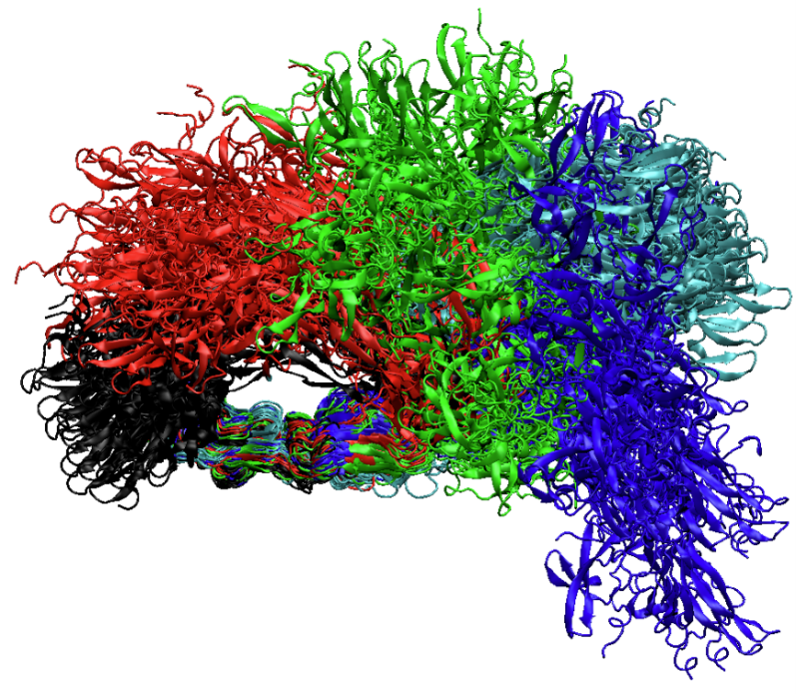
“Using molecular dynamics, you can take a protein, put it in a theoretical water box on a computer, and watch the way it moves. This can tell you a lot about its function.
For example, with B2GPI, there are two large loops at the bottom of the structure that determine whether it can bind to a cell. In the classical development of APS, the antibody binds here, and a clot is formed. With this genetic variant of the B2 protein, one of those two loops gets hidden, and so it can’t bind to a cell – preventing a clot from forming.”
This means that we could try to genetically screen people for APS.
This critical finding highlights the important role of the structure of B2GPI in how APS develops. It could also have significant implications for the future diagnosis of the disease.
“This means that we could potentially try to genetically screen people for APS. Many people carry these antibodies, but there is currently no way to know whether they pose a tangible health risk in patients with no autoimmunity. One thing we could do is look for this specific genetic variant and work out if a person is resistant to the antibodies or not.”
In the longer term, the findings could also have wider implications for people who do test positive for having APS antibodies. If researchers can find a way to induce the genetic mutation, it could be possible to prevent B2GPI from binding to cells, so that clots don’t form. This could prevent debilitating events, like strokes or miscarriages, from occurring in the first place.
Thomas credits our funding for supporting him to build new networks and empower his research. “The Medical Research UK fellowship is still paying off in crucial network building, which has been phenomenal for both me and my work.”
You can see the full study here >>


